McKinsey Maps the Future of Healthcare — Stellos Is Building It
What happens when one of the world's top consulting firms outlines the future of healthcare? At Stellos, we see validation — and opportunity. Here's why we're not waiting for the future to arrive.
3 min read
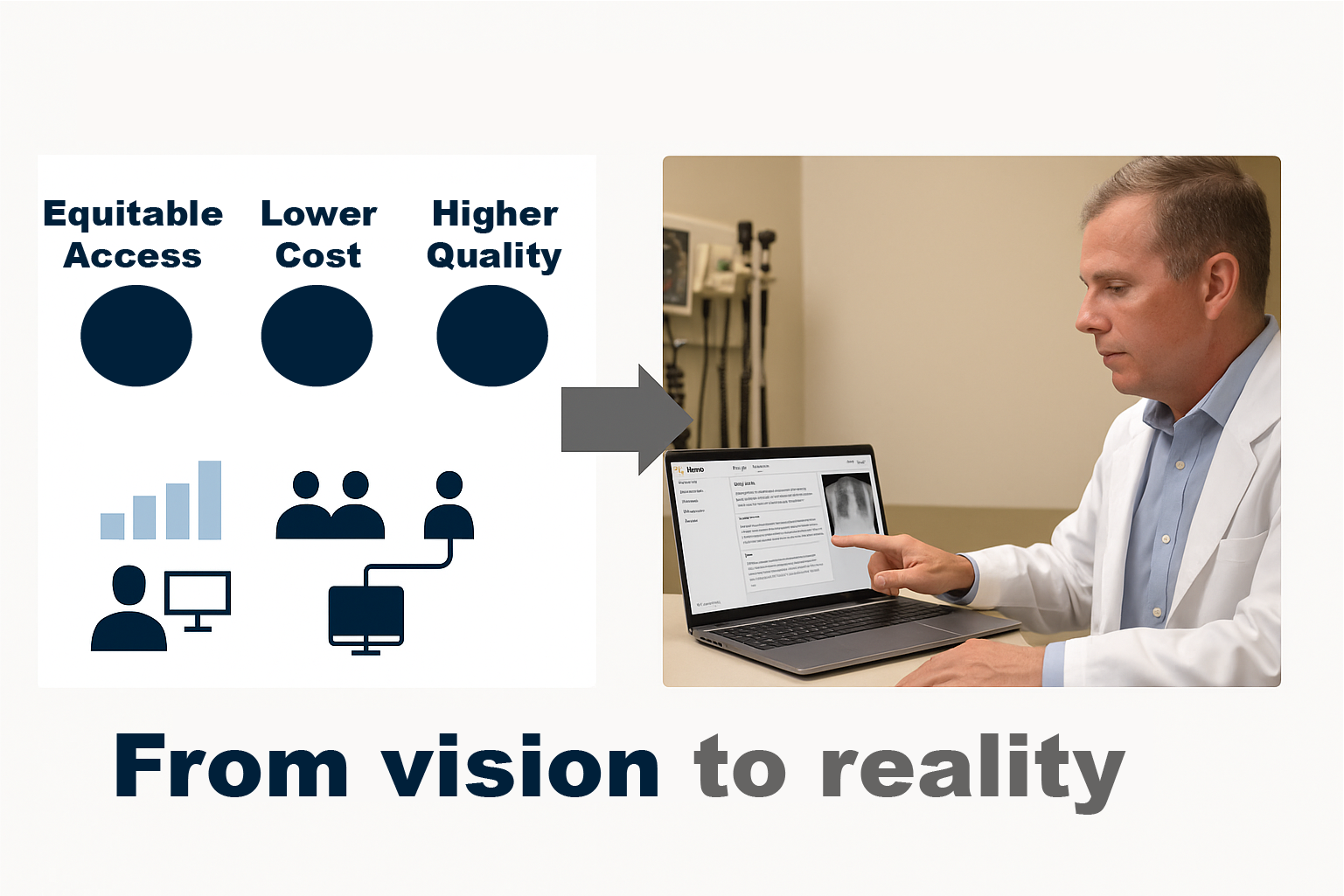
In a recent conversation published as "Patrick Finn on resilience, healthcare's mission, and AI's promise," McKinsey Senior Partner and global Healthcare Practice leader painted a compelling vision for the next two decades: healthcare built on resilience, personalization, and technology that empowers rather than replaces human expertise.
At Stellos, we couldn't agree more.
The Triple Aim Challenge
Finn makes it crystal clear: healthcare organizations must simultaneously deliver better access, lower costs, and higher quality care.
"If you're not balancing those three, you may find yourself in a tough spot — often sooner rather than later." — Patrick Finn, McKinsey & Company
This isn't just strategy speak. It's the fundamental challenge that drives every decision at Stellos. Kephra, our flagship clinical AI assistant, was engineered specifically to solve this triangle:
Access: Operates completely offline on standard hardware, reaching rural clinics, humanitarian deployments, and infrastructure-poor settings where cloud AI cannot.
Affordability: Eliminates ongoing cloud costs and connectivity requirements while providing enterprise-grade diagnostic capabilities.
Quality: Delivers medically-aligned diagnostics with transparent reasoning chains and continuous local adaptation that improves care over time.
The difference? While others are still planning how to balance these three imperatives, Kephra is proving it's possible in the field.
Resilience as Architecture, Not Aspiration
McKinsey emphasizes resilience as a fundamental organizational capability — the ability to adapt, learn, and thrive despite uncertainty.
That's exactly what Natural Enhanced Learning (NEL) delivers at the technical level.
Traditional AI systems become less capable when disconnected from their cloud infrastructure. NEL systems become more specialized and valuable through local adaptation. Constraints become advantages.
Stellos empowers healthcare organizations to function and improve:
With or without connectivity — intelligence that works in airplane mode
In fragile or rapidly changing environments — systems that adapt to local conditions
Through continuous local learning — intelligence that grows stronger through use
The world learned during COVID-19 how critical this kind of resilience is. We believe it should be permanent, not pandemic-driven.
AI That Augments — Not Replaces
Finn emphasizes the critical importance of human-centered AI deployment:
"We have to be thoughtful... about the role [AI] plays in healthcare versus the caregivers and patients who ultimately make decisions."
This perfectly captures our Ultimate Arbiter Principle. Kephra doesn't automate medical decisions — it explains, assists, and learns alongside clinicians.
How this looks in practice:
Transparent reasoning: Every diagnostic suggestion includes step-by-step clinical logic
Confidence communication: Clear uncertainty quantification for all recommendations
Alternative consideration: Multiple differential diagnoses and treatment pathways
Ultimate human authority: Final decisions always remain with healthcare providers and most importantly with the patient (the ultimate arbiter)
The result? AI that builds clinical confidence rather than creating dependency.
From Global Vision to Local Impact
Patrick Finn's roadmap for the next 10-20 years includes:
Seamless care navigation across multiple channels
Personalized insights delivered at the point of care
Integration of physical, mental, and social health factors
Empowered frontline teams with better decision-making tools
Reduced administrative friction and improved affordability
It's a powerful vision.
At Stellos, we're not waiting 20 years to deliver it.
Our first deployments are already demonstrating:
40% improvement in diagnostic confidence scores in rural settings
60% reduction in clinical documentation time through voice-to-SOAP automation
Zero degradation in performance during extended offline periods
Continuous adaptation to local disease patterns and provider workflows
Validation Through Action
Where McKinsey sees strategic opportunity, we see validation of our approach.
Stellos aligns completely with this vision, and we're grateful to see such clear thinking about healthcare's future. Our work with Kephra demonstrates that these principles can be implemented today:
Rural clinics where the nearest specialist is hours away
Humanitarian deployments with no reliable connectivity
Resource-constrained hospitals serving underserved populations
Independent practitioners competing with large health systems
The strategic insight: By solving for the hardest deployment contexts first, we create solutions that work exceptionally well everywhere else too.
Following the Right Roadmap
McKinsey's vision validates what we've believed from the beginning: the future of healthcare requires AI that is resilient, explainable, locally adaptive, and fundamentally collaborative with human expertise.
We're honored to be building technology that aligns with this thoughtful roadmap.
Kephra represents our commitment to this vision — AI that serves rather than extracts, strengthens rather than replaces, and grows alongside the people who use it.
McKinsey's roadmap gives us confidence we're building in the right direction.
If McKinsey's future of healthcare is about resilience, equity, and human empowerment, then we're grateful to be aligned with that vision and working to make it reality.
Join the Movement
The future of healthcare isn't something that happens to us. It's something we build together.
At Stellos, we're not waiting for permission or planning committees. We're deploying intelligent systems that work today while continuously improving through local partnership and adaptation.
The question isn't whether McKinsey's vision will come true.
The question is: will you help us build it?
Learn more about how Natural Enhanced Learning is enabling truly resilient healthcare AI at stellos.ai
support@stellos.ai